The Three Laws
The best conversations of my life have happened in cars. Something about facing the same direction, watching the same road, not having to make eye contact. You say things in cars you'd never say across a conference table. And in 2016, I was driving Henry King to the Austin airport in my beat-up Acura, the one with the coffee stain on the passenger seat that I'd tried to cover with a folder, and he was telling me something that would rearrange the inside of my head for the next ten years.
I should back up. I was Chief Digital Officer at the University of Texas, which sounds impressive until you realize it mostly meant being the person in the room explaining to people who'd been teaching for thirty years why the ground was shifting under their feet. I'd been doing this work since 2010, when I put an iPad in the hands of every incoming freshman at Seton Hill University. The iPad had existed for about five minutes, it didn't even have a camera yet, and most of higher ed thought we were out of our minds. By 2016, I wasn't the crazy one anymore. The forces I'd felt at Seton Hill were everywhere now, and I needed someone who could help me see past what was happening to why it was happening.
Henry King is that person. The Man of String, Oxford-educated, one of those minds that makes you feel like you've been thinking in two dimensions your entire life and someone just showed you the third. He didn't deal in trends. Trends are what consultants sell to people who want to feel current. Henry dealt in forces. The deep, structural, tectonic stuff that moves beneath the surface whether you're watching or not. He was my expert at UT, the one I called when everyone else's thinking stopped at the surface and I needed someone willing to drill. I loved learning from him so much that I'd personally drive him to the airport just to steal one more hour. My wife thought it was hilarious. "You're his chauffeur now?" I was. Gladly.
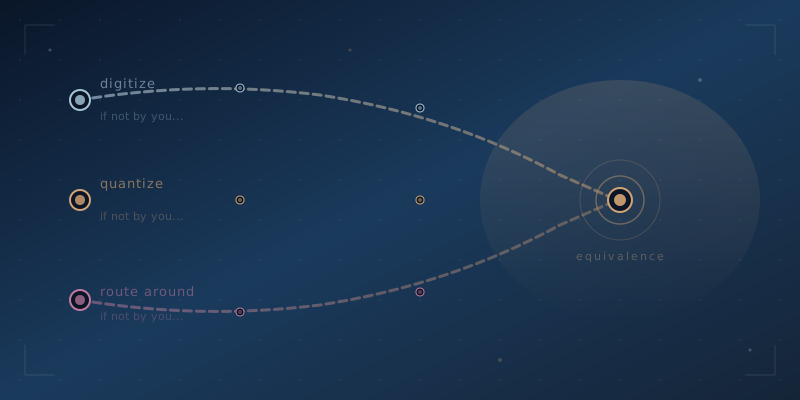
So there we were, Henry in the passenger seat, probably pretending not to notice the coffee stain, and he laid out three laws. He called them the laws of equivalence. Simple sentences. The kind that sound almost obvious when you first hear them and then keep detonating in your chest for years afterward.
The first: Any product or service that can be digitized, or made equivalent to another product or service, will be. And if not by you, then by someone else.
I remember gripping the steering wheel a little tighter when he said that last part. If not by you, then by someone else. That's not advice. That's a countdown.
Look, strip higher education down to the studs. Get past the ivy and the fight songs and the homecoming floats and the $200 textbooks with the professor's name on them. What's the actual product? Content delivery and credentialing. A person stands in front of a room, transfers knowledge, another person stamps a piece of paper that says the transfer happened. That's it. That's what the $80,000 buys.
Now ask Henry's question. Can that be digitized? Can someone or something else deliver the same thing?
It already has been, and it happened so fast it should make your stomach drop. An AI tutor can teach the same organic chemistry curriculum as a tenured professor. Patiently. Adaptively. At 2 AM, in Mandarin, at whatever pace the learner needs, without ever sighing or checking the clock or making a nineteen-year-old feel stupid for not getting it the first time. The content stopped being scarce twenty years ago when MIT put its courseware online. But the delivery, the interactive, responsive, meet-you-where-you-are delivery that was supposed to be the thing you could only get by showing up to a physical room and paying tuition? AI just made that equivalent too.
And the institutions that refuse to digitize their own value aren't protecting anything. They're just standing very still while someone faster builds it without them. Someone who doesn't have a football team to fund or a provost to appease or a thirty-year pension obligation or a building named after a donor who gets nervous about change. If not by you, then by someone else. Henry said it like a fact, not a warning. Because it is one.
The second law: Any product or service that can be quantized for effective distribution will be. And if not by you, then by someone else.
Quantized. I love that word. Broken into discrete units, distributable pieces. This is the one that should have every university president lying awake at three in the morning staring at the ceiling.
Higher education has always sold in bulk. Want to learn project management? That'll be a four-year degree, 120 credit hours, a meal plan, and $80,000. You can't buy just the part you need. You have to buy the whole bundle: the gen-ed requirements, the electives you'll forget by June, the mandatory freshman seminar on "finding your purpose" taught by an adjunct making less than your barista. The bundle is the business model. Always has been. And for decades, there was no alternative, so nobody questioned it. You don't haggle with the only store in town.
AI quantizes everything. Need to understand financial modeling? There's a six-week AI-powered pathway that gets you there, with competency-based assessment at the end that proves you can actually do it, results in hours, not semesters. The four-year bundle isn't being disrupted by a better four-year bundle. It's being broken into the exact pieces the learner needs, delivered exactly when they need them, for a fraction of the price. Micro-credentials, stackable certificates, skills-based hiring. These aren't trends. They're the second law arriving on schedule.
And here's what kills me. I talk to university administrators every week, and so many of them are still arguing about whether micro-credentials are "rigorous enough." Meanwhile, an employer in Dallas just hired a twenty-three-year-old who built a verified AI portfolio in eight weeks over someone with a four-year degree from a school with a very nice quad. The market doesn't wait for your faculty senate to form a subcommittee.
The third law is the one that has no mercy. I mean that. The first two are disruptive. The third is existential.
Any product or service that cannot be made equivalent will most likely be made redundant by another that is, through the forces of scientific and technologic advance and/or modularization.
Read that again. Slowly. Let it sit in your chest for a second.
Some institutions will argue, and they already are, that what they offer can't be made equivalent. The campus experience. The mentorship. The network. The intangible, irreplaceable magic of being in a room with other human beings who are also trying to figure out who they are at twenty years old. And you know what? They might be right. Some of that is genuinely special. I believe that. I've lived it.
But Henry's third law doesn't say those things will be replicated. It says they'll be made redundant. Not because someone builds a better version of the campus experience. Because the market builds a road that goes around it entirely. If you can't be made equivalent, you get routed around. That's not disruption. That's erosion. It's slower and it's worse, because you don't even get the dignity of a fight.
When an employer can validate skills through AI-powered assessment instead of checking for a diploma, the diploma doesn't get digitized. It gets bypassed. When a learner builds a verified portfolio of competencies through project-based AI learning, the transcript doesn't get quantized. It becomes irrelevant. The things that can't be made equivalent don't survive because they're special. They survive only if they deliver value that the equivalent alternatives genuinely cannot. And that's a much, much smaller list than most institutions want to believe.
I think about that car ride a lot. Henry in the passenger seat, the Texas sun flattening everything outside the windshield, both of us knowing these laws were going to take time to play out. We figured decades. Maybe a generation. The forces were real, but they were slow. You could see them working, but only if you squinted.
You don't have to squint anymore.
AI is the accelerant. What Henry described as forces, the slow tectonic movement of digitization and quantization and equivalence, just got a rocket strapped to it. What might have played out over thirty years is playing out in semesters. The institutions that see this, that recognize AI not as a shiny tool to manage but as the force Henry named ten years ago, have a window. Digitize your own value before someone else does. Quantize your own offerings before the market does it for you. Figure out what genuinely can't be made equivalent, the things only you can do, and pour everything you have into those. The laws don't change. The timeline just did.
I drove Henry to that airport in 2016 and I've been watching every word of it come true ever since. The iPad program at Seton Hill was just the first tremor. Everything since, the MOOCs, the bootcamps, the competency-based programs, the AI tutors, every single one is a data point on a curve Henry drew for me in the passenger seat of an Acura with a coffee stain and no idea how fast the future was coming.
If not by you, then by someone else.
Read Henry's original 2010 piece: Why Is Digital Technology Still So Disruptive? And while you're there, look at his art. The man thinks in more dimensions than most of us can see.
Ready to apply the three laws? Let's talk or join the conversation in Discord.