Labor Day, 2036
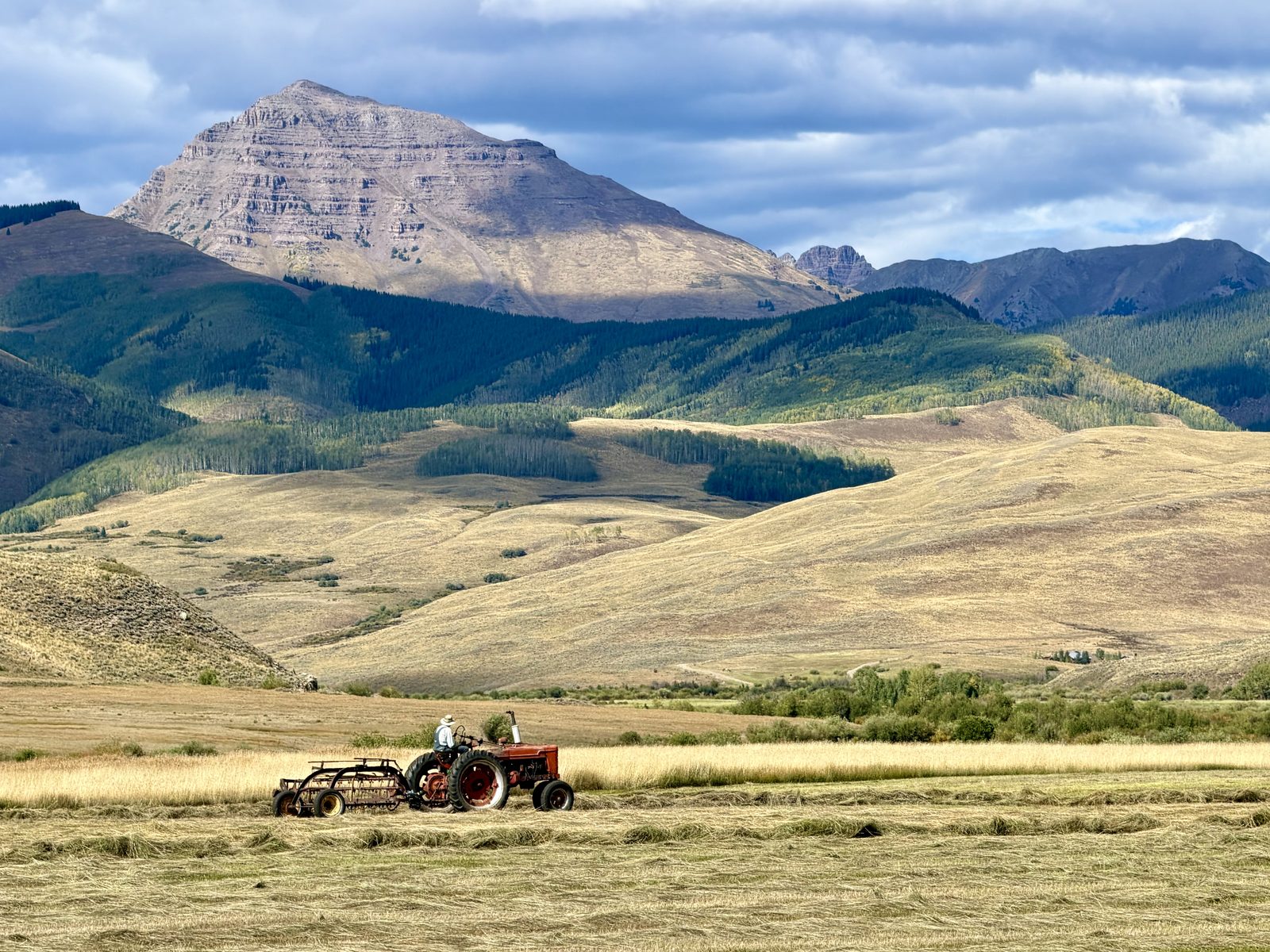
On the Sunday of Labor Day weekend, the Grand Traverse riders left Aspen at seven in the morning and came 40 miles over the Elk Mountains to Town Park in Crested Butte. Once the course had cleared, I went out for a spin of my own, like playing Augusta after the Masters, I'm just lucky enough to live near the 18th hole. About a mile from my house I stopped at the edge of a hayfield and watched a man in a wide-brimmed hat and long sleeves rake hay from the seat of a red tractor that has been raking longer than I have been alive. The rows lay behind him in long, even curves. The aspens in the draws were just starting to turn. I had to stop and save that moment. One family has worked this valley for more than 150 years. First by hand. Then by animal. Then by machine, soon by intelligence. Four generations, one field. The peak behind them, Teocalli, has not moved an inch the whole time.
I have never met him. I know his family the way you know families in a valley like this one: they are part of its history, and many families here are. They were working this ground long before I got here, and the work never needed me to notice it.
Please hold that picture in your mind. I will come back to it.
The Friday before the holiday, the Bureau of Labor Statistics reported that the American economy added 162,000 jobs in August. A fine number. Then, over the holiday weekend itself, a company in Palo Alto announced it was hiring 10,000 people in seven days. The work: watch videos of robots performing tasks and tell the machines what they got right and what they got wrong. Fifty to ninety dollars an hour, by the posting.
No AI experience required.
No degree required.
$50–$90/hr.
$104–$187k/yr.
That last line is my basic math, not theirs: 2,080 hours at the posted rate. Nobody will get 2,080 hours of it. It is a seven-day hiring window for a project with an end date. But that is the price a market put on plain human judgment this weekend, and the buyer never asked whether you had finished anything.
Ten thousand jobs teaching machines to work, posted on the weekend America sets aside to honor human labor. Not one of them will show up in that 162,000, or in any month's number after it. They are contractor positions. The payroll survey has no line for them.
That family had been working the valley for a decade when the first Labor Day parade stepped off in New York City on September 5, 1882. Some ten thousand workers gave up a day's pay to march from City Hall to Union Square. Ten thousand then, ten thousand this weekend, 144 years apart. The first ten thousand walked off the job to demand the eight-hour day.
Eight for work, eight for rest, eight for what we will.
The holiday they won carries a premise so deep in its bones that nobody says it out loud anymore: labor is compulsory, and rest is the scarce thing. A holiday celebrates whatever is scarce. Nobody has ever thrown a parade for oxygen, yet. So the celebration was a day off.
Now let's run the thought experiment. Take Elon Musk and the abundance crowd at their word. I do not, entirely. But the experiment is worth running, and this weekend handed us the data to run it with. The robots work. Energy gets cheap. Goods drift toward free. Work becomes optional, Musk says, the way growing your own vegetables is optional. You can. Nobody needs you to. Money does not matter. Again, thought experiment.
In that world the scarcity flips. Rest becomes the abundant thing, the default state. Effort becomes the rare one. And holidays follow scarcity the way water follows a grade.
The legend has it that John Henry raced the steam drill and died with the hammer in his hand, proving a man could still out-work the machine. This weekend's 10,000 are running his contest in reverse. They are not racing the machine. They are grading its swing: watching it work, marking the reps, telling it where the form broke down. The machine performs. The human judges. That is the trade now, and it pays better than driving steel into a mountain ever did.
The man on the tractor, the one I asked you to hold onto, made the same move generations ago. His great-grandfather's hands did the raking. Then the hands held reins. Then a steering wheel. Every wave of automation was supposed to empty that field, and every wave instead moved the man up one layer, from doing the work, to driving the work, to watching the work. Now intelligent machines will be running the machines. The next seat up is the one the 10,000 just filled: the judge.
So… Labor Day, 2036. If the abundance crowd is right, the holiday cannot keep meaning what it meant, because a day of rest is no gift in a world made of rest. The holiday inverts. Instead of celebrating with rest, we celebrate the human effort it takes to do anything, including building out the land of abundance that Elon and others are predicting. The first Monday of September becomes the day you bake the bread by hand, split the wood, write the letter with a pen, rake one field the slow way. A festival of effort. Sweat as observance. Blisters as liturgy.
We have watched this conversion before. The factory made handmade a premium. The car made running a sport with medals. The supermarket made gardening a devotion people defend with real heart. When machines "take over" a labor, the labor does not vanish. It migrates, from necessity to meaning. There is no reason to believe cognitive work is exempt. Judgment, taste, care, human conviction, and confidence all become more valued in an automated era.
I have some standing here. I taught myself everything I know. In 1985 I graduated high school straight into the internet. Not the browser-based one, but the one underneath it, all archaic protocols, where the only way to learn it was to do it. Make the mistake. Do not make it twice. Aka, learning. I got interested enough to start a small ISP, and when browsers showed up and became a new "language" for turning all that data into something a person could look at (as rich as HTML 1.0 allowed, which was not very), I learned that one too. That has been my toolbox ever since. Or call it a digital paintbrush: the paint, the tech, changes, but the artist remains. How that paint gets applied to new and existing problems has always been my curriculum.
No degree. No curriculum. Nobody assigned the work, and for years nobody paid for it. The effort was the education. It took four decades for the economy to start pricing what that kind of unassigned effort produces. This weekend it was paying up to ninety dollars an hour for the judgment, $187,000 a year if the year existed, with the credential requirement set to none.
Forty-three million Americans have some college and no degree. In the old scarcity, that sentence describes a deficit. In the flipped one, it may describe the largest reserve of unpriced judgment in our country. An interesting thought experiment, like I said. I am not betting the ranch on Elon's timeline.
But I would take one bet today. By 2036, something autonomous may well rake that valley, owned by the family, I hope, running all night, the hay indifferent either way. And on the first Monday of that September, a man will still walk out to the old red tractor, climb into the seat, and rake a few rows himself. Not because the valley needs him to. Because it is his to do. And because when the Machine Stops, everything does. (Forster, 1909. UC Davis still assigns it to computer science majors in an ethics course.)
That was always the holiday. Labor Day never celebrated the jobs. It celebrated the people who spent themselves doing them, and it assumed the effort would never run short. The machines can have the work. The effort stays ours. A decade from now, we may finally find out which one the day off was for.
Wondering which seat your people move up to when the machines take the work? Let's talk or join the conversation in Discord.