The Blinking Cursor
On my porch the agent opened a telegram chat to alert me of an anomalous run of our agentic platform Noviant, the chat came to me, over the air, on my porch.
[9:01am] ⛔ 1 scan(s) stalled mid-pipeline — marked errored.

Now from a 'super computer' (Mac m5 128gb ram) over a Starlink dish to a satellite and back to my Mac wirelessly, me on my porch overlooking a mountain about to be skied. I ski Teocalli, it's not lift served, I believe in earning my turns. And the thing I'm looking at is a blinking cursor.

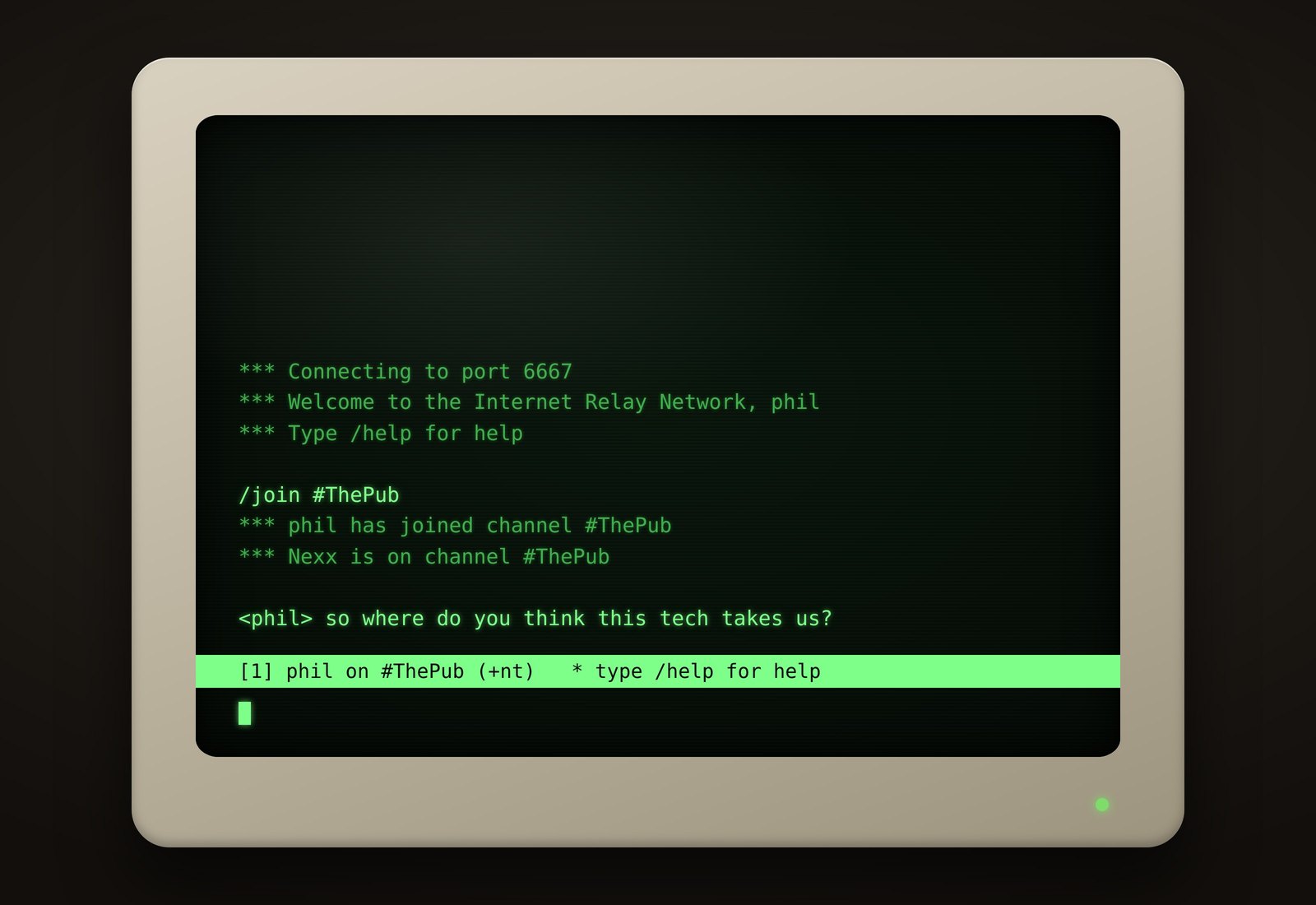
36 years later we are back at the blinking cursor. I've been at the launch of each. When I found IRC it wasn't two years old yet.
Night after a baseball game, sweaty and dirty but my friends at university of Pitt Greensburg allowed this nerdy baseball player in to use the 'Internet gateway'. I didn't have a modem, yet, but soon would and this trek would be replaced by booting up and logging in from home…
/join #ThePub
#ThePub - exactly what it sounds like. An English pub. A very international group that felt like walking into Mos Eisley spaceport in Star Wars, if you had an imagination. :)
A grad student that went by Nexx from RPI and I geeked out about where this tech might take us. Just knowing that others shared my wonderment was the UX. Community is contagious, I would spend hours chatting about what's to come and might be the best education I've had.
That room was a student's fix for a buggy bulletin board. In the summer of 1988 Jarkko Oikarinen was running a Sun server at the University of Oulu in Finland, and the board's chat program, in his words, had a bad habit of not working properly. So he wrote a replacement, called it Internet Relay Chat, and turned it on at the end of August. He has said he doesn't know the exact day.
Here is what it looked like from the chair. One line at the bottom of the screen where you typed, and everything above it scrolling up and away. Monospace, usually light on dark. Your name could be nine characters long; that was in the spec, and Nexx had five to spare. A message could be 512 characters, counting the two invisible ones that ended the line. Everything you did that wasn't talking started with a slash. /join. /nick. /msg. /me, which turned "/me shrugs" into a little stage direction with your name on it. No bold. No pictures. No undo.
And nothing was stored. Read that again. Your words went from your server to the next server to the next, each one passing them along and forgetting them. If you weren't in the channel when something was said, it was never said, as far as you were concerned. You couldn't scroll back past the moment you arrived. Sometimes a link between servers dropped and half the channel vanished mid-sentence. A netsplit. You'd wait for the wall of names to come flooding back. You had to be in the room.
Then from my home over a 2400 baud modem. Newly married, one phone line, you had to pick the right time to hijack the phone line for this purpose. Rode the wave to 56k :)
At 2,400 bits a second a full 512-character line took about two seconds to arrive. You didn't read a message. You watched it come in, one character after another, like someone typing to you from across the room.
Then for thirty-some years we decorated the room. Windows and icons, the web, feeds, apps, the little red badge with a number in it. Every one of those was an improvement, and every one put more between you and the person on the other side. To think we've spent billions, maybe trillions of man hours and money on creating 'experience' - all we needed was a blinking cursor connected to intelligence (or what seems like it) to entrance everyone with 'their experience'.
On November 19, 2026, Anthropic started trading on the Nasdaq under ANT. It priced at $83 a share and raised $81.3 billion, the largest IPO in American history. Strip away the valuation and the S-1 and look at what people actually use. A box at the bottom of the screen. Text scrolling up. A cursor. Someone on the other side who answers.
Through this simple terminal like interface, billions have been engaged. Compare that with one person in a dirty baseball uniform in a library computer lab - grad student or AI - same difference now.
Put the two screens side by side and the list of differences is shorter than it has any right to be. Anthropic's tool for programmers, Claude Code, runs in a terminal, monospace, light on dark. Type a slash and the commands appear. /help. /clear. The answer comes back a few words at a time, which the engineers call streaming and which looks exactly like a stranger on a slow line typing back.
Even the forgetting came back. The model doesn't remember you the way a database does. It knows what's in the window in front of it. Close the session and the room empties. Products bolt memory on around the edges, the way IRC clients once bolted on logging, but the thing at the center is still a relay with no past. You have to be in the room.
What changed is the pipe and who's on the other end of it. The library gateway was backhauled to Pitt's computing center in Pittsburgh, and in 1988 one of the thirteen sites on the national internet backbone was the Pittsburgh Supercomputing Center, run jointly by Carnegie Mellon and Pitt. My first words on the internet most likely went out through a supercomputer center; 36 years later I'm typing on a 'super computer' of my own. This morning my words go up about 550 kilometers to a satellite, across to a ground station, out to a data center and back down to a porch in Colorado, and the whole trip takes less time than one of those modem lines took to paint.
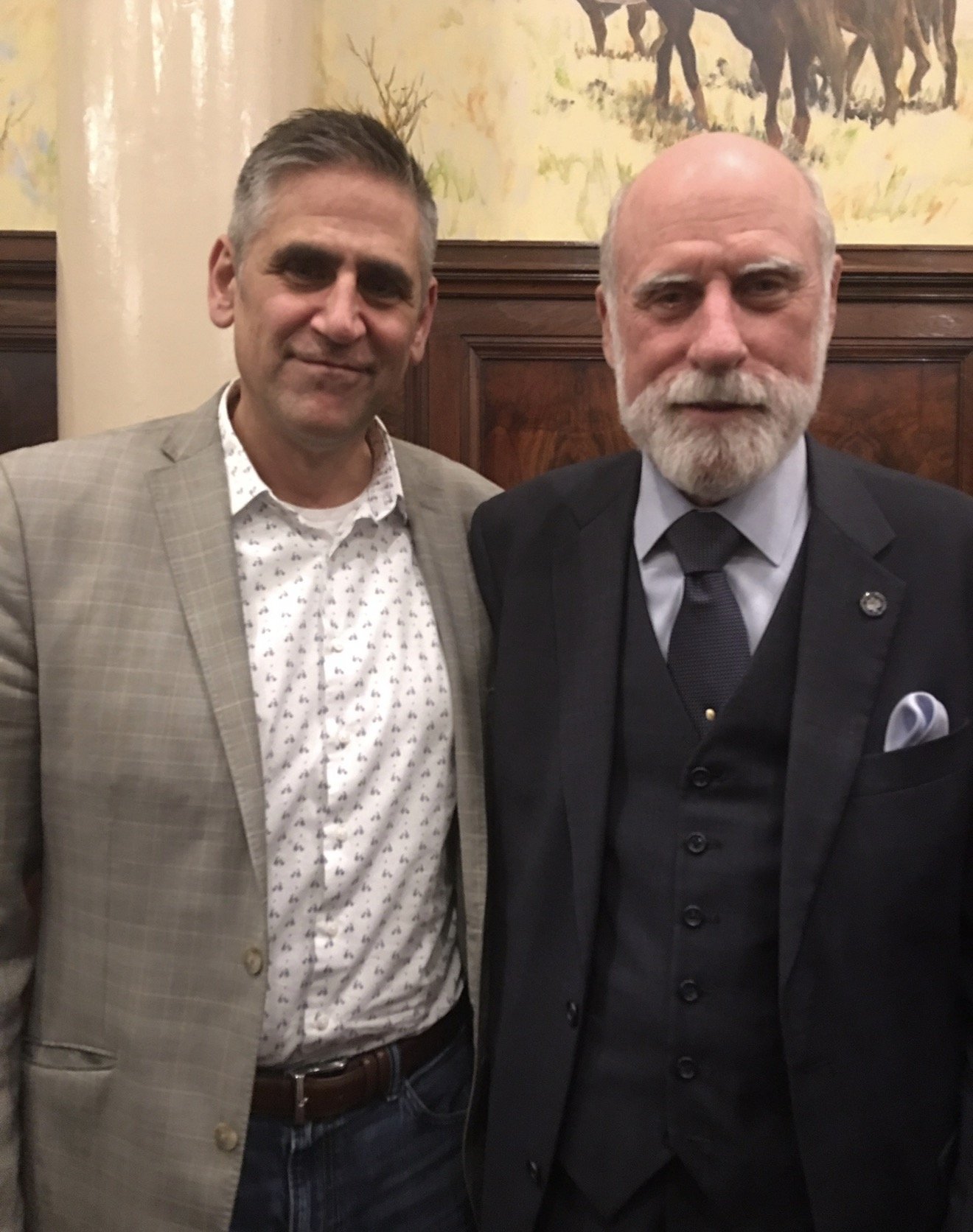
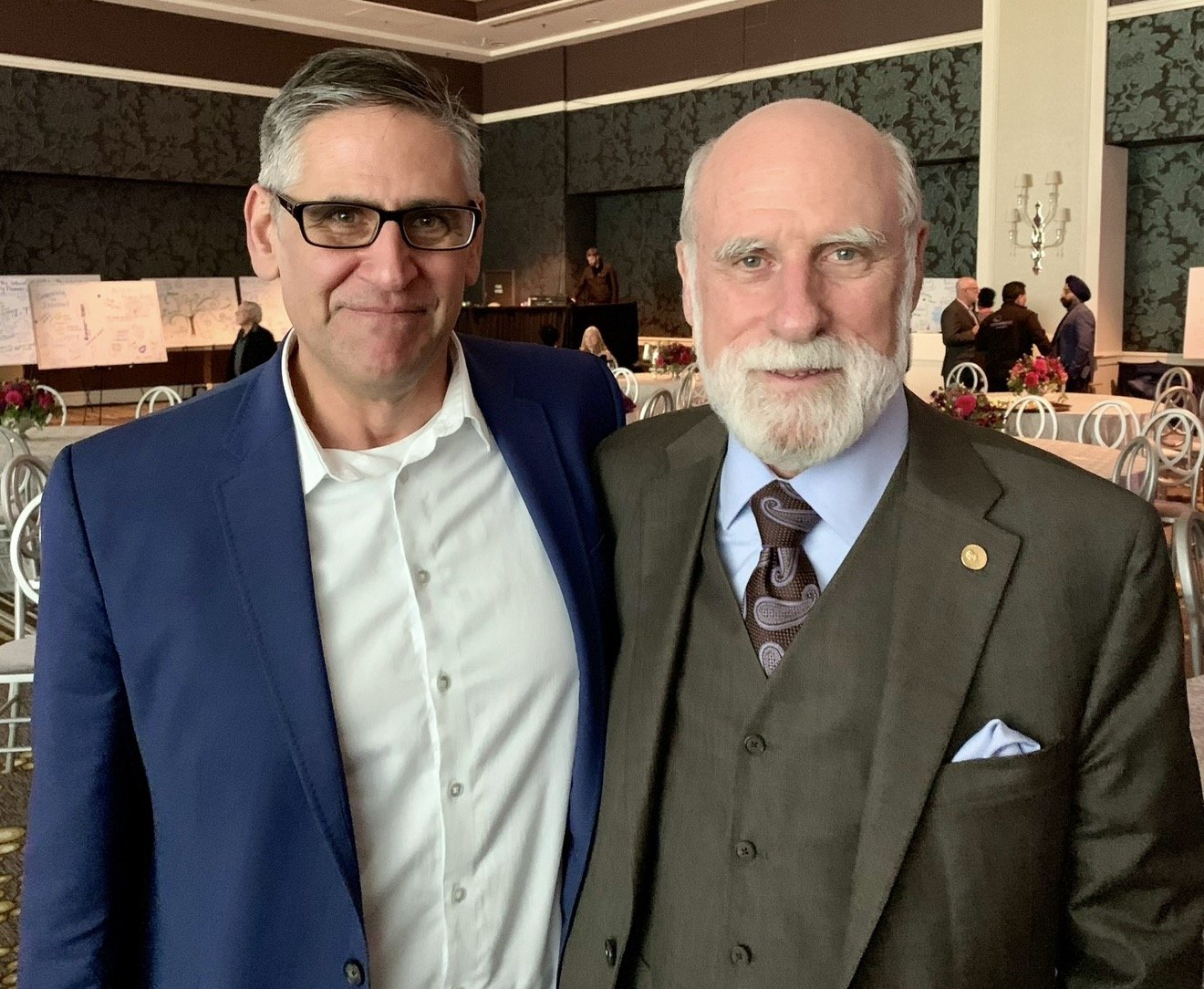
Every hop on both routes speaks TCP/IP, the protocol Vint Cerf and Bob Kahn designed in the 1970s. Met Vint in Austin at an IEEE VIP dinner during SXSW in March 2017, invited by a UT colleague, and then again in December 2018, when he and Tim Berners-Lee hosted a gathering on the future of the internet and human rights, on the 70th anniversary of the Universal Declaration of Human Rights. To think that I had the honor and pleasure to meet Vint on a few occasions shows how small the world is and how much connecting people matters. Vint and TCP/IP has connected the planet, not Facebook.
In February 1995 Neal Stephenson published The Diamond Age, and at its center is a book. A Young Lady's Illustrated Primer, commissioned by a rich lord for his granddaughter. The engineer who builds it makes an illicit copy, gets mugged, and the copy ends up with Nell, a four-year-old on the wrong side of town, handed to her by her brother. The Primer tells her stories built around her own life. It trains her. It raises her. And the part people forget is that the machine wasn't doing the talking. Most of the voices in Nell's book belonged to one woman, an actor named Miranda, performing live, who becomes the closest thing Nell has to a mother. I don't remember the first time I read Neal's book. But the primer stayed with me.
The Primer needed a person on the other end. So did IRC: a pub full of strangers and some bots holding the door. We all now have a primer, instead of a room full of humans chatting back.
Now each of us has that with AI. If the computer was Steve Jobs's bicycle for the mind, AI in this context is a rocket ship.
Wondering what your people would type if the cursor answered back? Let's talk or join the conversation in Discord.