The Gray Twilight
On February 18, 2021, a parachute opened seven miles above Jezero Crater. Seventy feet across, red and white, and the pattern that looked like decoration was binary. Red for one, white for zero. It said DARE MIGHTY THINGS, with the coordinates of the Jet Propulsion Laboratory around the outer ring.
Here's the part that reorganizes it. There were cameras on the backshell pointed up, at the canopy. So for two minutes of descent, the machine falling toward Mars had those words directly overhead, filling its entire field of view.
The message wasn't for us. We were fourteen light-minutes away and could not have done a thing about it. It was hung where the thing doing the daring would see it. A rover, alone, at the worst moment of its life, at 12,000 miles an hour, looks up and gets told why.
Most people have the quote filed under the wrong speech.
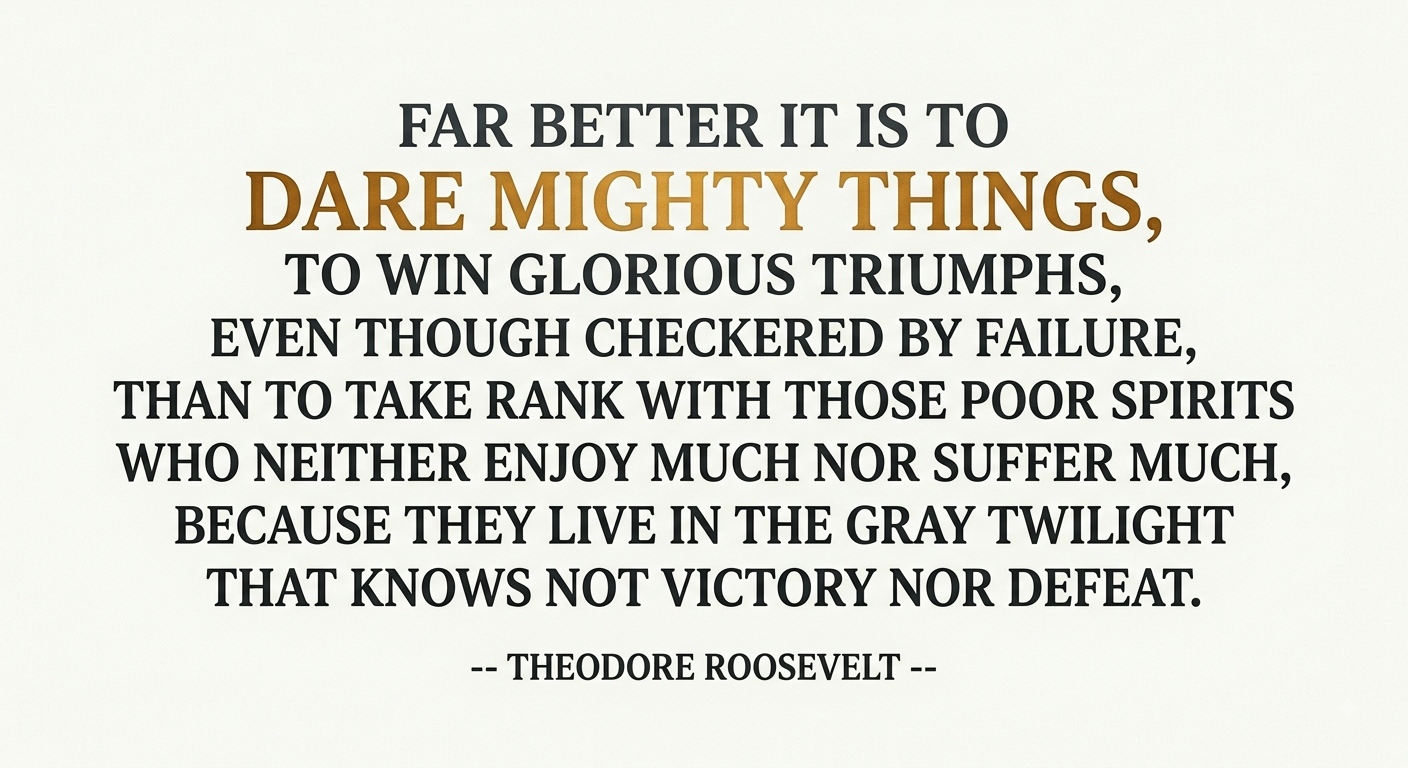
That isn't the Man in the Arena. The Arena speech is Paris, the Sorbonne, 1910, Roosevelt out of office and playing elder statesman. This one is earlier and meaner. Chicago, the Hamilton Club, April 10, 1899, Roosevelt at forty and three months into the governorship of New York, telling a room full of comfortable men that ease is a moral failure.
And the gray twilight is not a metaphor for failure. Failure is in the other half of the sentence, and Roosevelt respects it. His contempt is saved for the ones who arranged their lives so that nothing much could happen to them either way.
Which brings me to higher education.
The standard critique of ed-tech is about data. Who holds the student records, where the CRM exports go, what the exit clause says. That's the conversation we're comfortable having, because it has a procurement answer. But the data was never the crown jewel. The work was.
It went one reasonable decision at a time, which is what makes it worth writing about. First the machines, because nobody sane wanted a data center in the physical plant basement, and that was correct. Then the software, which sounds like buying a database and is actually buying a definition of what a student is. Institutions with three-hundred-year-old charters reorganized themselves around a vendor's data model because the alternative was a change order. Then the process, adopted from the implementation consultant because it was faster than explaining your own. Then the expertise, which leaves in that consultant's laptop bag and comes back in five years as a discovery workshop you pay for again.
Watch what it leaves behind. A registrar evaluating a single transfer credit opens one system to find the transcript, a second to look up the equivalency rule, and a third to record the decision, because nobody ever reconciled them. One process, three logins. And she is the reason it works at all, because she is the only remaining place where those three systems connect to each other.
Then, finally, the work itself. Under a typical online program manager arrangement, a company fronts the capital for your online degree and takes fifty to sixty percent of tuition on a contract running ten years or more. They do the marketing, the recruiting, the course design, and the retention coaching. Read that list and tell me what's left for the university.
What's left is the seal. The one thing in the arrangement that cannot be purchased, and it is precisely the thing being rented out.
2U, the biggest of them, bought edX for $800 million in 2021 and filed for Chapter 11 in July 2024. So ask what the partner universities retained. Ten years of operating an online program, and they did not learn how to operate an online program. That's the part that should keep people up at night, and it isn't the money; the money's just money. A decade in the arena, by proxy, and no muscle to show for it.
Which brings me to the question I cannot get a good answer to, from anyone, in any room.
Name another industry that sells a six-figure product and lets a stranger to the brand conduct the first conversation.
A degree is the second-largest purchase most people ever make, and unlike the first one it can't be resold, refinanced when rates drop, or discharged in bankruptcy.
Apple ran straight into this and rebuilt the company over it. From 1997 they ran a store-within-a-store inside CompUSA. Apple's design, Apple's products, Apple's branding, sitting in somebody else's building and staffed by somebody else's people. The reasonable, moderate, board-approvable version. It failed on exactly three things Apple could not control: the expertise of whoever happened to be standing there, the environment around the moment of choice, and every minute after the customer paid. So in early 2000 Jobs hired Ron Johnson out of Target, and the first Apple stores opened in May 2001. The day after the first one, BusinessWeek ran the headline "Sorry, Steve: Here's Why Apple Stores Won't Work."
The lesson isn't that the columnist was wrong. It's what Apple concluded from the CompUSA years, which was not "we need a better partner" and not "we need tighter brand standards in the agreement." It was that the first touch is not marketing for the product: it is the product, and a company that doesn't own it does not own what it makes.
Every university running a vendor-built, university-branded enrollment funnel is operating a store inside a CompUSA. It has your seal on it. It is not your floor space.
The rest of the six-figure world already knows this. Four Seasons puts every candidate for every position in front of the general manager. Rolex sells through boutiques it controls. A private bank does not send a contractor to the first meeting with a twenty-million-dollar prospect. Even the car dealership, the nearest thing to a counterexample, wears the badge over the door and gets audited on the floor tile, and Tesla still spent a decade fighting fifty statehouses for the right to skip the arrangement entirely.
But every one of those companies ends the arc at the sale. A university's relationship with a student is supposed to run sixty years. Orientation to reunion to the estate gift.
One organization understood that, and it wasn't a university.
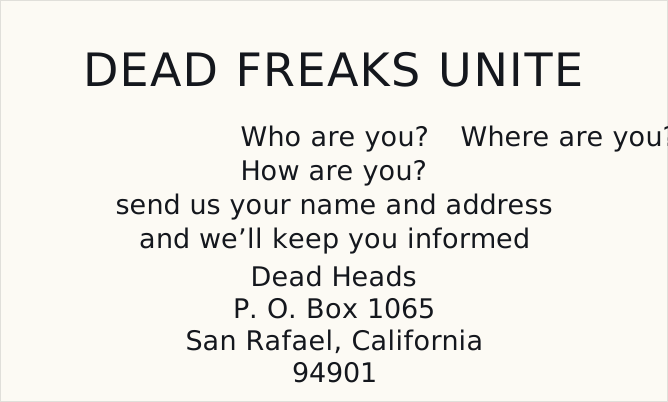
In 1971 the Grateful Dead slipped an insert into a live album. Not a tour schedule, not an order form. It read: DEAD FREAKS UNITE. Who are you? Where are you? How are you? Send your name and address to Dead Heads, P.O. Box 1065, San Rafael, California. A rock band, in the era when the label owned every relationship a musician had, asking its people to identify themselves directly to it.
By 1983 that list had become a box office. Grateful Dead Ticket Sales, run by the band's own staff, taking mail orders from fans who hand-decorated the envelopes. They weren't permitted to advertise it, so you found out from a phone hotline or from whoever stood next to you in a parking lot. About 24,000 tickets that first year, and more than 600,000 a year by 1995. When Ticketmaster wanted ninety percent of the inventory, the band refused and went on selling its own seats to its own people.
And they let the audience tape the shows. In 1984 they built them a section to do it from, while the rest of the industry was suing people for precisely that. They gave away the recordings and kept the only thing that was ever load-bearing, which was knowing every person who cared and having a direct line to each one.
They gave away the data. They kept the work.
Now take the test, and I mean actually take it this week. Ask someone at your institution to walk you end to end through how a transfer credit is evaluated. Not the policy, because the policy is on the website and the policy is fiction. Then ask how the census-day enrollment number is produced, the number that goes to the board and the one the bond covenants reference. Watch the room. Someone will eventually say we'd have to open a ticket.
Open a ticket. To learn how your own institution counts its own students.
Every person in that room is competent and overworked and inherited this, so I don't say it to be cruel. But higher ed has a talent for naming things gently, and this needs naming. It isn't technical debt. It isn't legacy complexity. It's an institution that can no longer describe itself.
And here's the part I'll get letters about. A lot of leaders prefer it this way, because outsourcing is the finest risk-transfer instrument ever sold to a nervous administrator. Build it yourself and it fails, and that's your name on it when the board asks in March. When the vendor fails there's an escalation path, a credit on the next invoice, and a sentence that begins "we're working closely with our partner." Nobody gets fired for the vendor's outage.
That's the actual product. Not the software, but someone else to be responsible.
And it works so well that the institution stops noticing it has arranged its affairs so that nothing much can happen to it either way. No glorious triumph, no honest failure. A renewal date. A slide on the second Tuesday that says Phase 2 On Track, and everybody nods, and the thing you can feel in your chest if you sit in enough of those rooms is that nothing is wrong and nothing is happening.
Neither enjoy much nor suffer much. Roosevelt had the whole thing in 1899 and he wasn't even talking about us.
The same salespeople are back now, new banner over the same ballroom carpet, selling AI. If you buy your AI strategy the way you bought your SIS, you will not be renting software this time. You'll be renting the institution's capacity to reason about itself, which is a considerably worse thing to have on a subscription.
Except the economics changed. The entire logic of "you can't build it yourself" rested on one fact: you could not out-engineer a vendor with four hundred developers. That was true for thirty years. It is not true now, and the people saying it loudest have a quota. A small team with coding agents can build the system that fits the institution instead of contorting the institution to fit the system. And what comes back isn't velocity. It's a registrar who can explain the transfer rules again, because she wrote them, in plain language, and the system runs what she wrote.
Which matters most for the thing that can't be outsourced at all. Accreditation isn't a badge you display; it's an attestation you make. When a university confers a degree it is saying: we know what this person can do, because we did the work of finding out. You can hand off the infrastructure. You cannot hand off the knowing. If you do it anyway and keep signing the diplomas, you're not running a university. You're running a licensing business with a nice quad.
So, back to the parachute.
Remember where they aimed it. Not at us, but up into the cameras of the thing that was falling, so that at the single worst moment, with no help coming and everything burning, the machine had the reason overhead in letters seventy feet wide. And underneath the reason, the address of the people who believed in it. You were made on purpose. Here's the address. Now land.
Ask what your institution would encode facing inward, for itself, to read on the way down. For a lot of places the honest answer is a statement of work. Thirty-one pages, deliverables in Appendix C, a clause governing change orders.
Roosevelt's poor spirits weren't beaten. That's what people miss when they hang the quote in the hallway. They didn't lose, they never entered. There's no scoreboard in the gray twilight, no highlight reel, nothing checkered by failure, because there was never an attempt to check.
The way out is not a better vendor, and it's not a sharper RFP or a governance committee with a charter. The way out is to do the work. Badly at first. In public. With your own people, whose names you know, who will still be in the building in five years, holding what they learned.
Checkered by failure. But yours.
Ready to take the work back? Let's talk or join the conversation in Discord.