UX to MX
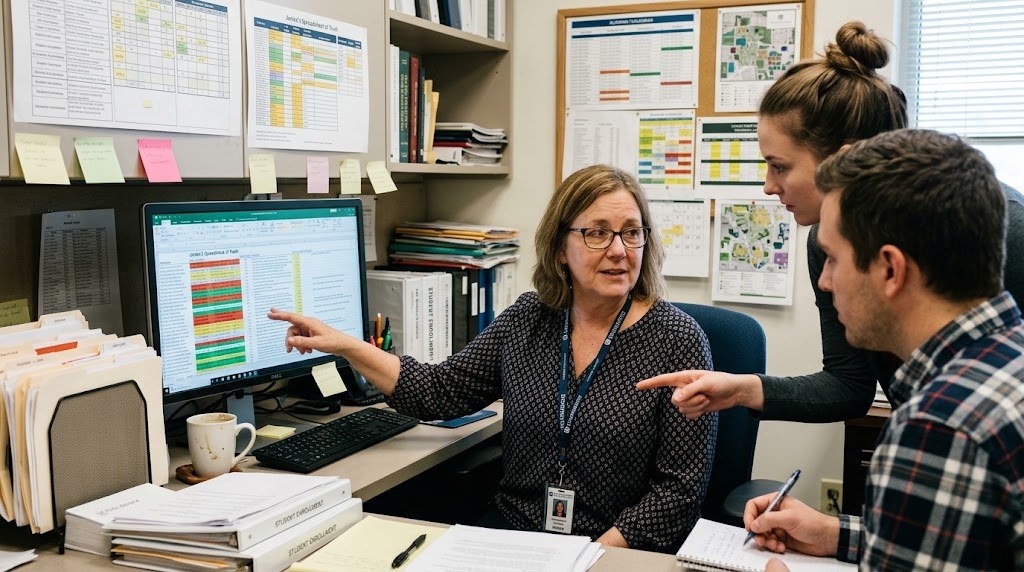
Meet Janice.
She isn't real. She's also on every one of your campuses.
Janice runs enrollment for a program that didn't exist three years ago. Her team qualifies a lead differently than the rest of the university. They enroll a learner differently. Every program carries requirements of its own.
None of it fits the form.
The form came from the vendor. It was built for the business the institution used to be, and the enterprise foundation underneath it is still standing. Stable, yes. Also rigid. The shape of the business is changing, and has, but the enterprise foundation remains. Being inflexible in times of drastic change never is a good thing.
So Janice keeps a spreadsheet, and should.
Everybody knows about it. It's the file people actually open before a meeting. Call it Janice's Spreadsheet of Truth, because nobody really believes what's reported out of enterprise interfaces.
She has company. In a 2021 BlackLine survey of about 1,300 executives and finance professionals, 70% said they weren't confident the financial data they work with is accurate.
Seventy percent.
Every campus runs a shadow ERP. Most of it lives in a folder called something like FINAL_v9.
I've sat with a lot of Janices and Jerrys. One of them recently let us try something.
We started with a schema of their data mart. Then we asked for a flat-file extraction of the tables that held what her team needed. One pull.
Over a weekend, that file became something I call data freedom. AI as the UI. Her data, shaped the way her team actually works, answering the questions they actually ask.
Monday morning she said it: this is what I always wanted data to look like.
Not five screens in two different systems, distilled by her into her Spreadsheet of Truth. A visualization of the actual data, compiled the way she always wanted to see it.
That's how assumptions get extracted from ERP systems, without intention.
That was win #1. What the screen showed was the enterprise's culture, where its data lacked and where it was strong. The real magic happens when others around the table start to ask "What if..." or "Can we..."
Language changes and dreaming begins. We are in an era of digital enablement. Build that language. You are going to need it.
For forty years, we designed experiences around screens, big and small. We built portals and drove people to them. Log in here. Click there. Your record lives in our system, on our terms.
Now AI is the new UI, and people are free to use their data the way they always wanted to.
Leadership needs to meet their customers where they are, not where they are used to driving them to. A UX needs to be an MX.
My Experience.
A few months ago I wrote about the ampersand, the person in the middle who sees two trades as one problem. Someone with a deep understanding has the power to at the very least create an art of the possible with AI. Couple that with a trusted way to deploy and manage agentic intelligence and workflows, and you now have created the MX I speak of.
That second half is where it gets a bit more difficult.
There's a company called Taalas that bakes a language model straight into the silicon. The weights live in the chip. You can try it at chatjimmy.ai. It answers at roughly 15,000 tokens a second.
Researchers at Caltech put conscious human thought at about 10 bits a second. In tokens, that's two or three.
Roughly 6,000 times faster.
🤯
When a model is baked into the silicon, the agents now work about 6,000 times faster than we do. That has to redefine "working together."
Every trust mechanism on a campus assumes a human in the loop, moving at human speed. Logins. Approval chains. A data governance committee that meets the second Tuesday of the month. By the time it convenes, an agent has finished a semester of work.
These current frames of auth and security are forever broken with this new capability.
So where does trust go?
Into the data. With an agentic fabric that corrals and manages agentic work, trust lives with the data. The rules about who can touch a record, and why, travel with the record. The agent checks at machine speed. The humans audit at theirs.
That's why we built Seraphian. Seraphian gives you the architecture to trust the data and the agents when the time scale that humans work on vs. agents is not even in the same ballpark.
Here is the part presidents and provosts won't like.
You don't need another piece of tech. Your data holds the ontology you always needed, and now more than ever because of AI. Janice's spreadsheet is a piece of it. Every workaround on your campus is a piece of it. No vendor can sell it back to you.
Beth Rudden said it best: "You don't build ontologies. You excavate the ones that were always there, hiding in your assumptions."
Excavated. Not bought.
If you don't invest in your data, you will miss all the affordances of this era.
We haven't gotten to the end of this yet. Janice's team has moved from that first data freedom demo to a scoped POC. After the call we huddled, and what would have taken months in the very near past will take days.
From dream to delivery is days.
When you can trust that kind of speed, and value is being delivered, how can't things change?
When someone sees this, SaaS to Sovereignty becomes understood. Every investment in data, not in SaaS, compounds like interest. It affords the organization the freedom to interact with each of its users in their way, on their terms, with the data they need to trust, and now can.
Dashboards will quickly become the new fax machine.
Somebody on your campus keeps a Spreadsheet of Truth.
Go find Janice.
Know where your Janice keeps her spreadsheet? Let's talk or join the conversation in Discord.